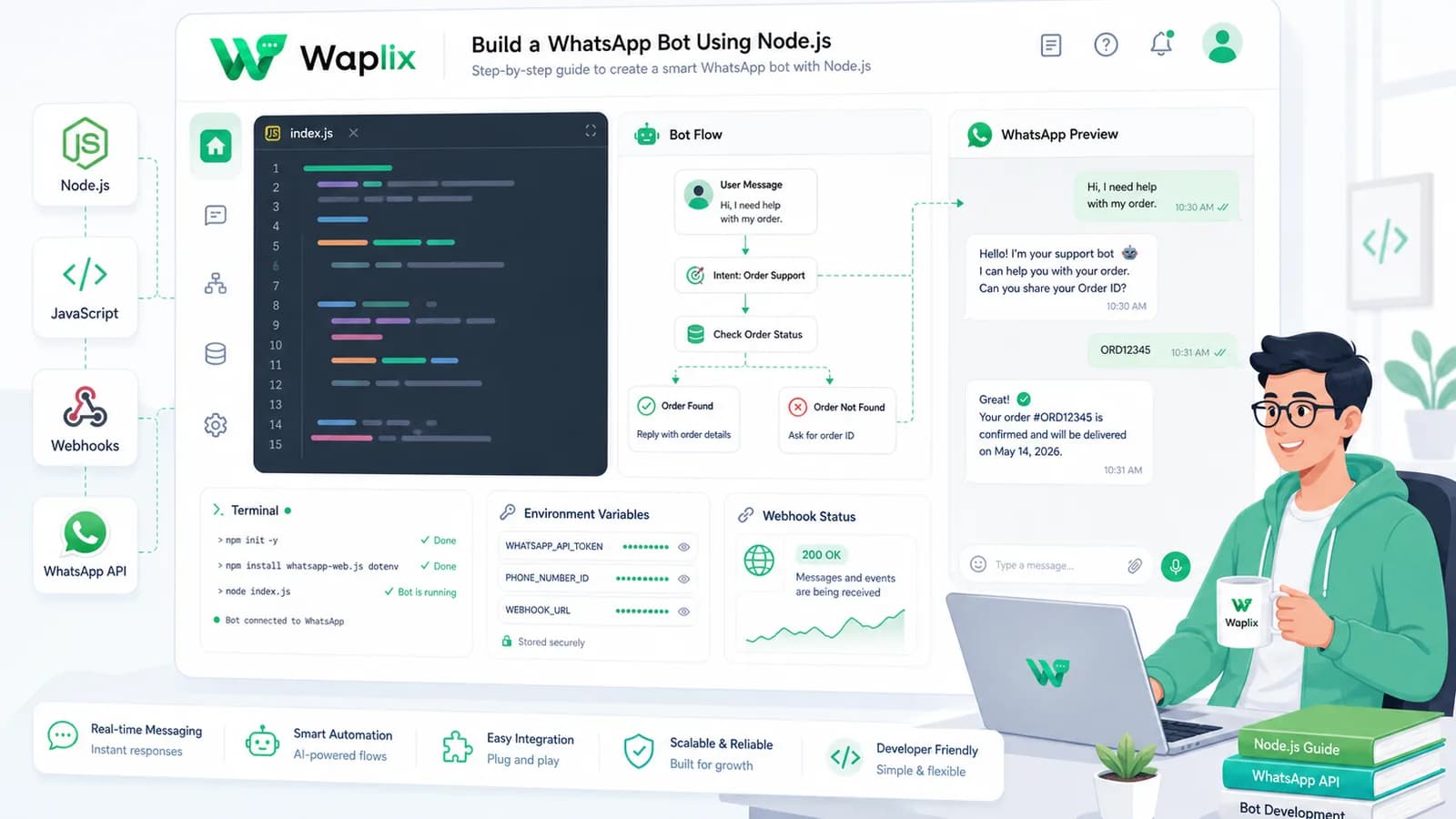
Relying on legacy tools or running blocks without database state files will lead to broken bot conversational flows. Building an Express.js router with signature validation and queue support is standard. Follow this step-by-step bot guide.
Dec 15, 2025 11 min read By Waplix Team
Share:
Deploy intelligent WhatsApp bots with Waplix
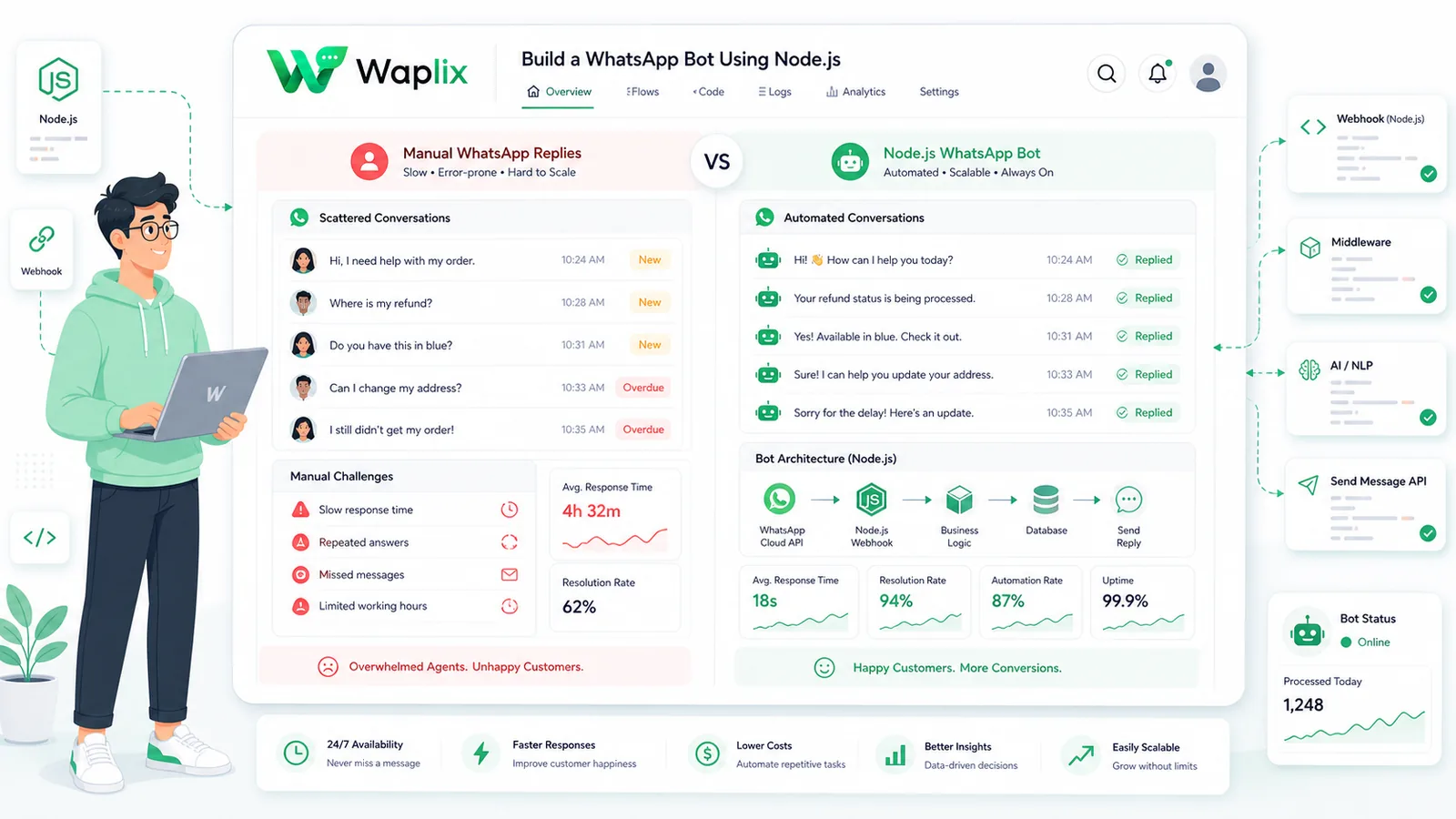
Automating customer support requires intelligent conversation flows. While basic keyword auto-responders are easy to configure, building conversational bots that fetch order statuses, update booking records, and query AI engines demands a structured server backend. Node.js is the preferred framework for this task.
Creating a reliable Node.js bot requires configuring Express webhook routes, validating requests, managing conversational states, and writing dispatch handlers. Without these elements, users will experience broken conversation flows or message dropouts.
This developer guide details how to build a WhatsApp bot using Node.js. We will examine environment setups, comparison tables, development steps, technical diagrams, and complete code blocks to get your bot running.
Overview: A Node.js bot routes incoming messages through an Express HTTP listener, parses customer intent, queries databases or AI models, and sends replies back via API POST calls.
Receive pre-parsed JSON, manage webhook retry queues, and track bot interactions from our secure dashboard.
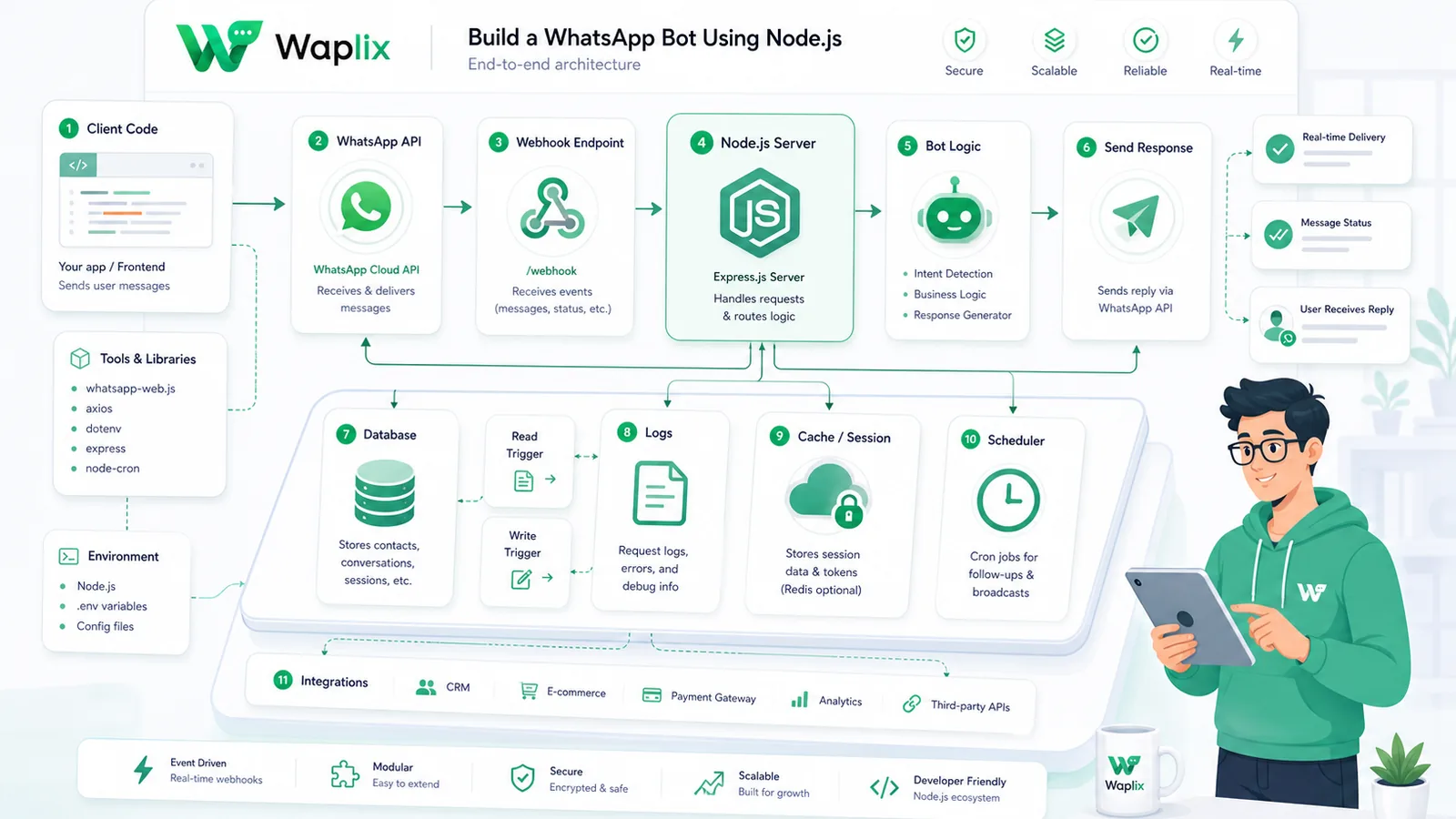
A WhatsApp bot functions as an event listener. When a customer sends a message, Meta forwards a JSON payload to Waplix, which signs the header and routes it to your Node.js endpoint. The server processes the text, updates state logs, and triggers a response.
This table compares the different conversational architectures you can deploy on Node.js.
Bot Class
Routing Mechanism
State Storage
User Interface Advantage
Rule-Based Bot
Keyword matching (e.g. if/else rules).
Stateless or cookie variables.
Fast response. Zero API model cost.
State Machine Bot
Visual dialog trees and menus.
Redis or SQL sessions.
Guides users through transaction steps.
AI-Powered Bot
Natural language processing (NLP / LLMs).
Vector databases and chat history.
Handles open-ended queries gracefully.
Hybrid Bot
State machine with AI backup.
Unified session storage.
Combines structured paths with AI flexibility.
By connecting systems, you can trigger specific messages based on customer behavior—such as confirming a booking, following up on a delivery, or recovering an abandoned shopping cart.
Hybrid bot setups route structured flows through state machines, using LLM models to resolve unstructured questions.
Core use cases for bot automation
Enforce clean message structures across all bot conversational nodes.
1. Transactional order confirmations
Send confirmations and purchase details instantly when checkout completes. These transactional updates keep customers reassured and reduce check-in inquiries.
2. E-commerce cart recovery
Trigger recovery reminders when shopping carts are abandoned. Personalizing templates with product names and checkout links helps recover lost sales.
3. Automated shipping and tracking updates
Integrate delivery updates to notify customers as their package changes hands, providing proactive transparency throughout fulfillment.
4. Out-of-office and away responders
Set up automated responders to handle inbound chats outside business hours, set response expectations, and route urgent queries to triage queues.
Key Takeaway
Prioritize transactional alerts and utility automations first. Establish high delivery rates and compliance metrics before launching promotional broadcasts.
Step-by-step bot development setup
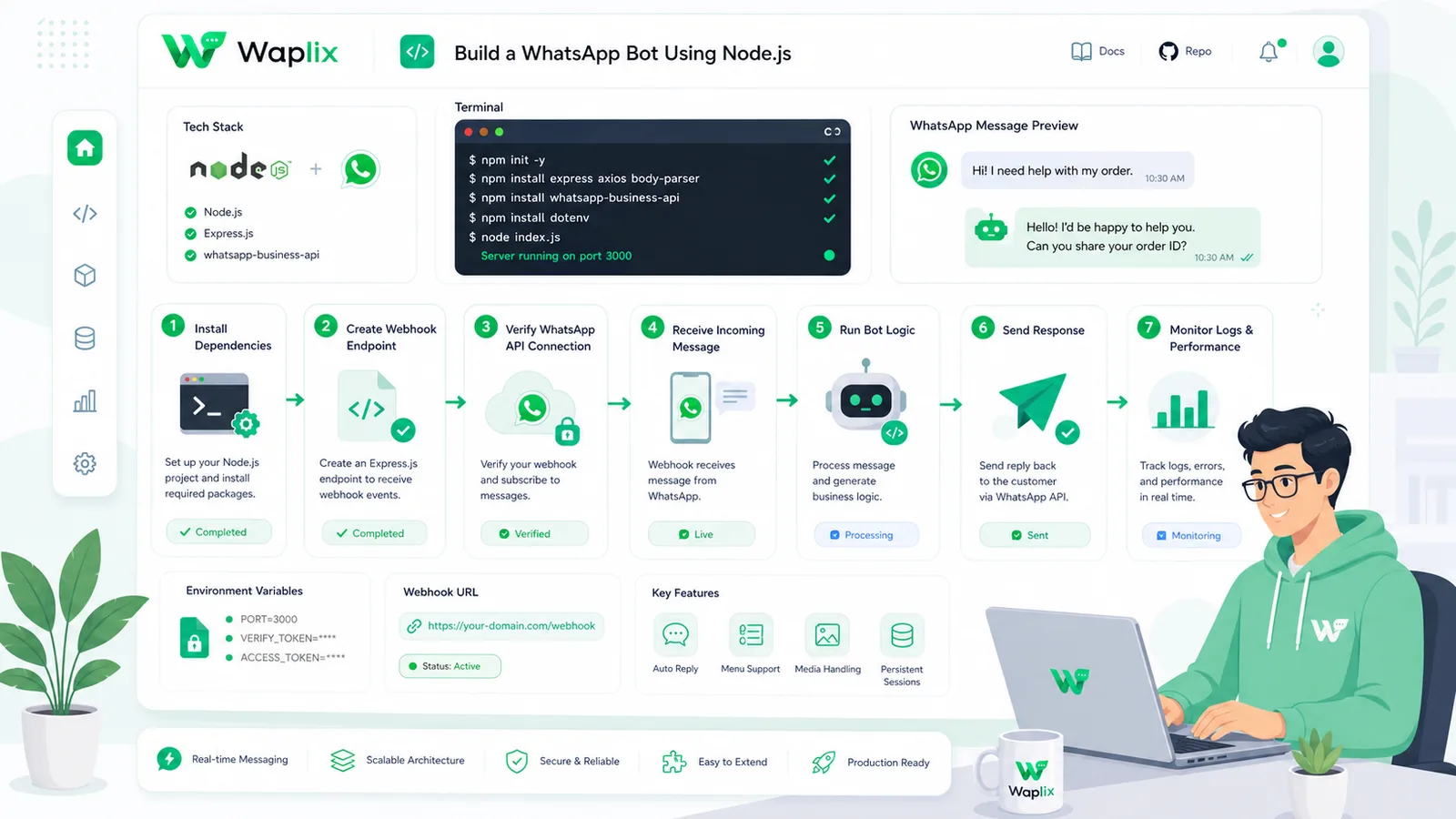
Setting up your WhatsApp automation workflows requires careful planning. Follow this step-by-step guide to get started.
01
Register your API number
Register your business number through Waplix. Connect it to your Meta Business Manager and pass verification.
02
Design dynamic templates
Write and submit utility and marketing templates containing placeholder variables for Meta approval.
03
Map event triggers
Identify target business events (e.g. checkouts, bookings) and configure system webhooks to fire payloads.
04
Set up consent checks
Integrate opt-in filters in signup and checkout forms to check contact consent status before sending messages.
05
Design the reply routing
Configure automated auto-replies or route replies to a shared inbox so agents can handle manual follow-ups.
06
Monitor metrics & adjust
Analyze delivery statuses, open rates, and opt-out metrics to optimize message timing and template copy.
Automation Tip: Collect documented consent at checkout. Confirming consent protects your number quality score and keeps campaigns compliant.
Bot response routing pipeline
A bot routing pipeline inspects and directs messages to target handlers. This diagram outlines the logical decision tree.
The routing pipeline evaluates session state, parses intent, and dispatches automated replies.
Incoming user messages are parsed for active intent. Standard FAQs are resolved instantly by your AI support agent. Complex issues route to human queues, where agents collaborate to resolve them and log performance metrics.
Technical data flow and architecture
A reliable customer support setup requires seamless sync between Meta's WhatsApp servers, your help desk software, and your business backend databases.
The Node.js server coordinates payload verification, database session checks, and outgoing message sends.
When an internal event occurs, your system fires a webhook. The Waplix engine validates the phone format, checks active marketing opt-ins, selects the target template, and submits the payload to Meta's servers for delivery.
This section provides a complete Express.js example of a WhatsApp bot listener that processes incoming text messages and responds dynamically based on content.
1. Complete Express.js bot server
Implement a route that handles the webhook GET verification and parses incoming POST text messages to send replies.
const express = require('express');
const axios = require('axios');
const app = express();

app.use(express.json());

const WAPLIX_API_URL = 'https://api.waplix.io/v1/messages/send';
const WAPLIX_API_KEY = process.env.WAPLIX_API_KEY;

// GET Webhook verification handshake
app.get('/webhook', (req, res) => {
  const token = req.query['hub.verify_token'];
  const challenge = req.query['hub.challenge'];

  if (token === 'my_bot_verification_token') {
    return res.status(200).send(challenge);
  }
  return res.sendStatus(403);
});

// POST Webhook listener
app.post('/webhook', async (req, res) => {
  // Acknowledge payload receipt instantly
  res.sendStatus(200);

  const event = req.body;
  if (event.event === 'message.received' && event.data.type === 'text') {
    const fromNumber = event.data.from;
    const userText = event.data.text.body.toLowerCase().trim();

    // Process bot logic and match keyword intent
    let replyText = "Sorry, I didn't catch that. Type 'help' to see available options.";
    if (userText === 'hello' || userText === 'hi') {
      replyText = "Hello! Welcome to our automated WhatsApp support. Type '1' for order status, or '2' to speak with an agent.";
    } else if (userText === '1') {
      replyText = "Please enter your 6-digit Order ID to check status details.";
    } else if (userText === '2') {
      replyText = "Routing your chat to our support team. An agent will reply shortly.";
    }

    // Dispatch automated reply payload
    await sendBotReply(fromNumber, replyText);
  }
});

async function sendBotReply(to, text) {
  try {
    await axios.post(WAPLIX_API_URL, {
      to: to,
      type: 'text',
      text: { body: text }
    }, {
      headers: { 'Authorization': `Bearer ${WAPLIX_API_KEY}` }
    });
  } catch (error) {
    console.error('Error sending bot response:', error.message);
  }
}
Developer Security Note: Always store your API keys securely in your environment variables. Validate incoming webhook signatures server-side to ensure payloads originate from Waplix.
Operating a customer support desk on WhatsApp requires strict adherence to Meta's messaging policies and local data privacy laws.
Opt-in verification. Businesses must secure explicit consent before sending outbound transactional alerts or ticket updates to customers.
The 24-hour service window. Free-form messages can be sent within a 24-hour service window opened by a user's message. Messages sent outside this window must use pre-approved templates.
Opt-out controls. Include clear opt-out options (such as quick-reply buttons like "STOP") in your templates to make unsubscribing easy and protect your quality rating.
Follow local privacy laws. Ensure compliance with GDPR, TCPA, and other relevant regional regulations.
Compliance Note: This guide provides operational advice, not legal counsel. Regulations vary by country and region. Always consult qualified legal advisors to ensure your messaging strategies comply with local laws.
How Waplix manages API credentials securely
Waplix provides small businesses with official WhatsApp API access, eliminating the complexity of managing server infrastructure. Build workflows, manage templates, route replies to a shared inbox, and view campaign analytics—all from a single, unified platform.
Verify that incoming payloads contain user message arrays before running bot processing functions.
Provide human escape routes
Ensure users can opt out of automated flows and transfer to a human support agent at any time.
Secure environment variables
Store API keys in server configurations and add environment files (.env) to .gitignore.
Manage conversation state
Use lightweight cache systems (e.g. Redis) to store and update conversational state logs.
Conclusion and next steps
Building a WhatsApp bot with Node.js is an effective way to automate customer support workflows. Exposing Express listeners, validation headers, state tracking, and fallback routes ensures a stable integration.
Set up your Express workspace, secure developer tokens, test callbacks with local tunnels, and verify user states to begin your integration.
Build secure WhatsApp integrations with Waplix
Create a developer account, connect your business number, and automate customer support at scale.
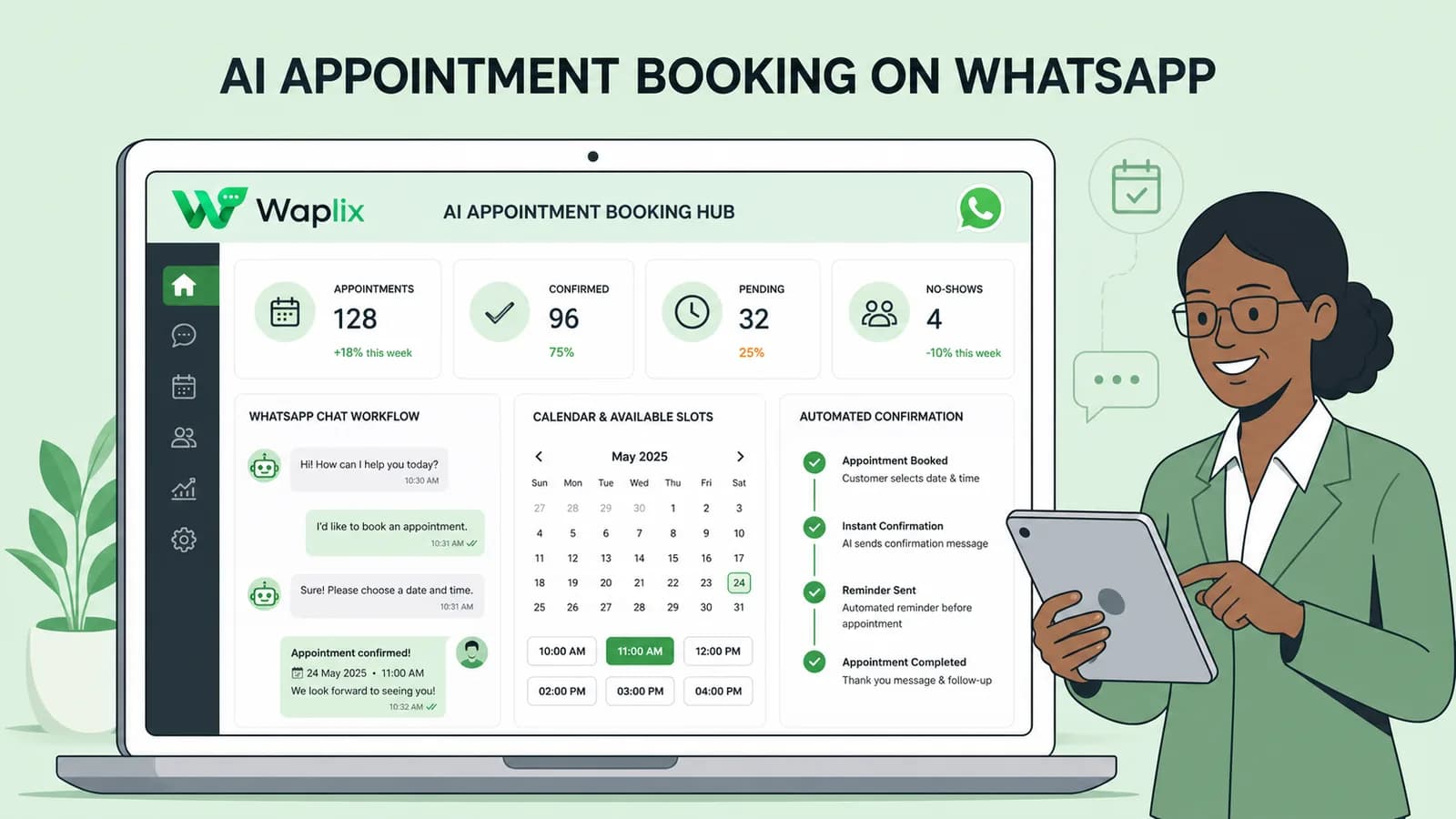
Learn how to build AI-driven booking systems on WhatsApp, connecting calendar databases to conversational agents, automating updates, and reducing client no-shows.
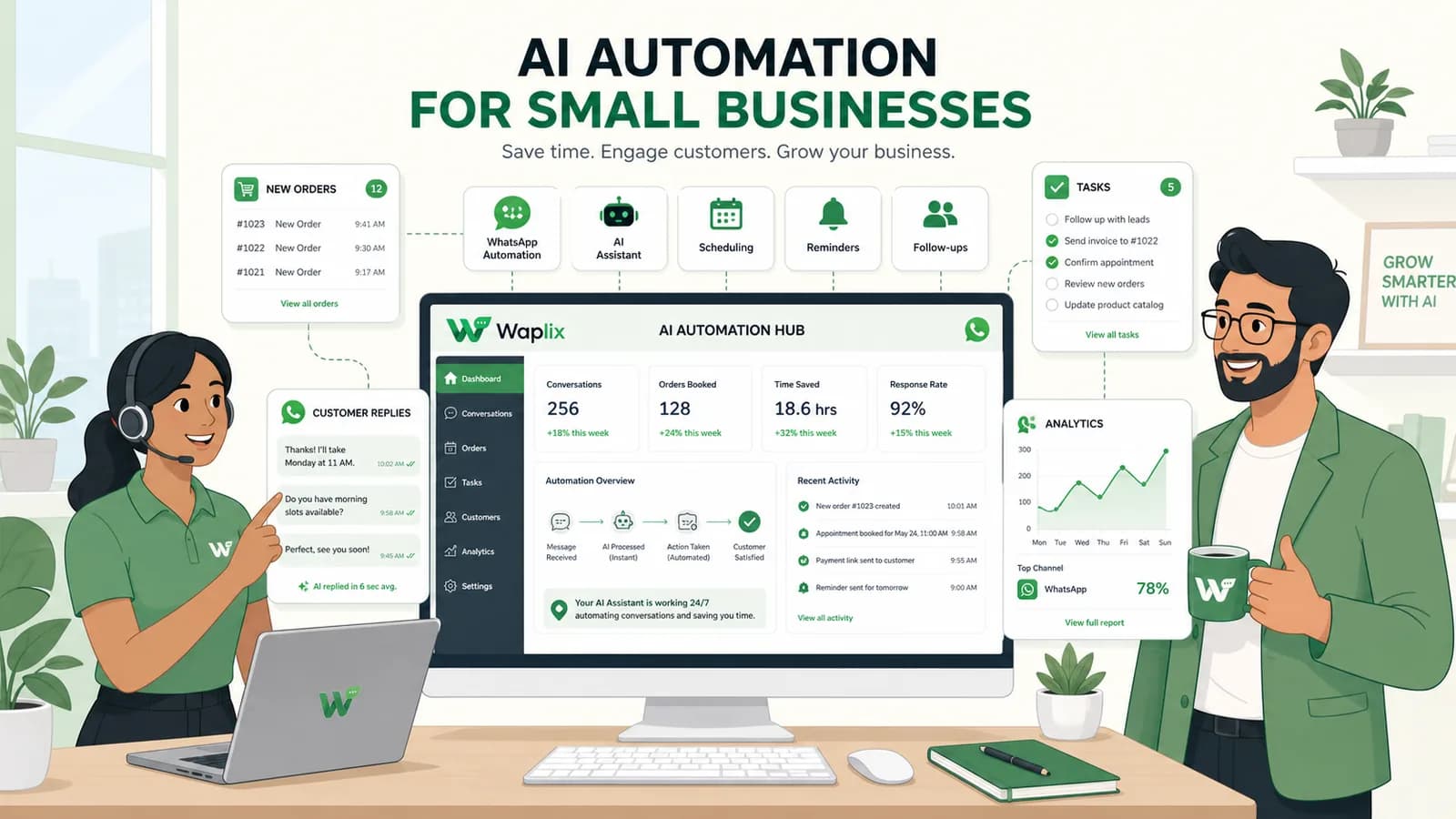
Discover practical ways small businesses can leverage no-code AI automation on WhatsApp to manage customer conversations, qualify prospects, and coordinate bookings 24/7.
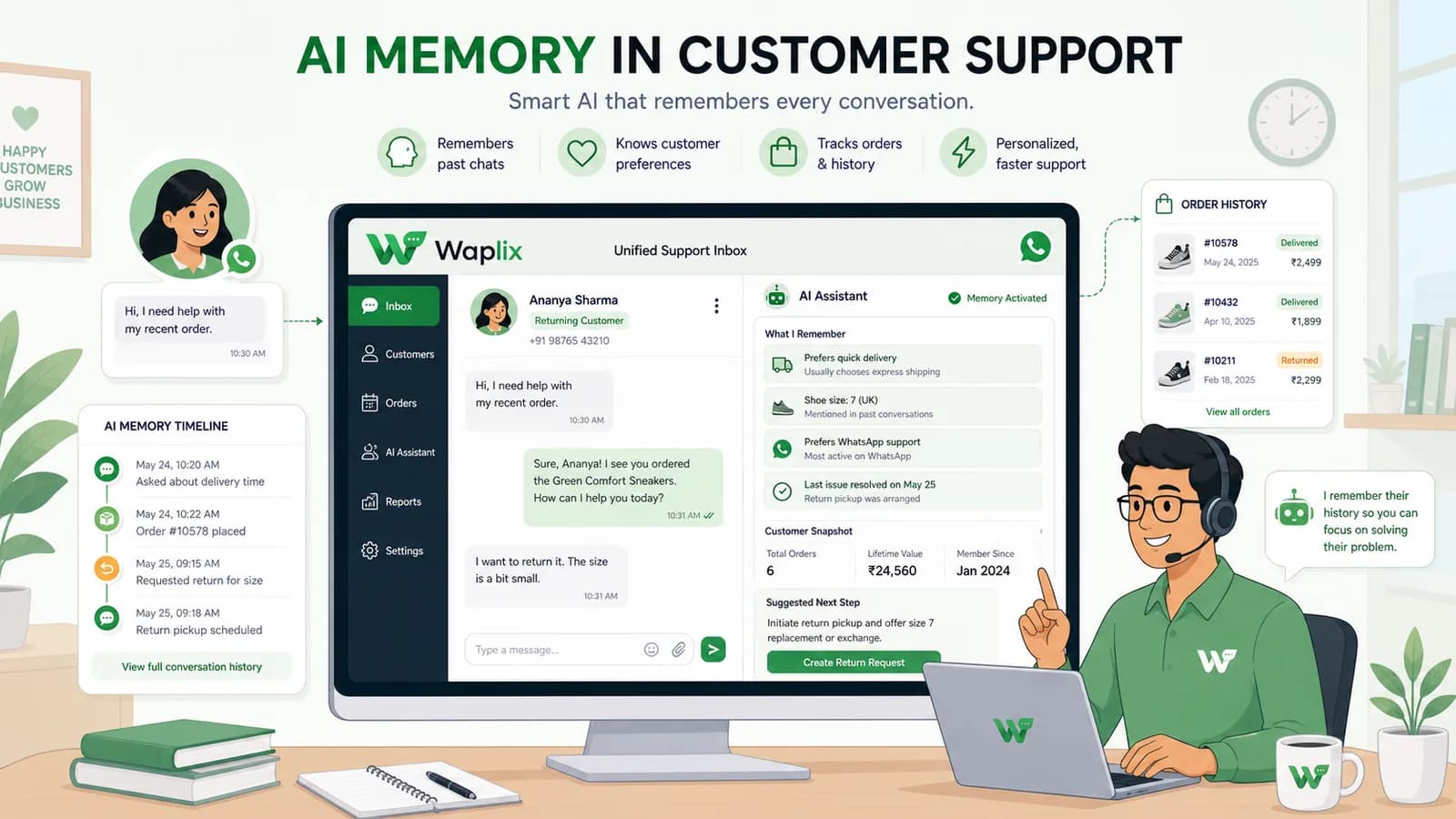
Explore the technology behind AI memory and context retention, learning how session databases personalization results in better, trust-filled client interactions.