Comparisons

AI vs Human Customer Support

The AI vs human support debate misses the point. Customers do not want a bot or a person—they want the fastest accurate help with the least friction. This guide compares both sides and shows when hybrid WhatsApp support workflows win.

Aug 29, 2025 14 min read By Waplix Team
Share:
AI vs Human Customer Support

Start building with Waplix

Support leaders are under pressure from both sides. Leadership wants lower cost and faster response times. Customers want empathy, accuracy, and easy access to a real person when automation fails.

That tension created a false choice: AI or humans. In practice, the strongest support operations use both. AI handles repetition and triage. Humans handle judgment, emotion, and exceptions.

This article compares AI vs human customer support across speed, quality, cost, trust, and scalability—with practical guidance for WhatsApp and modern messaging channels.

Quick answer: AI wins on scale and first-response speed. Humans win on empathy and complex judgment. Hybrid support with clear handover usually beats either approach alone.

Combine AI support agents, human handover, shared inbox workflows, and WhatsApp messaging in one platform.

Create your free Waplix account Explore AI agent documentation
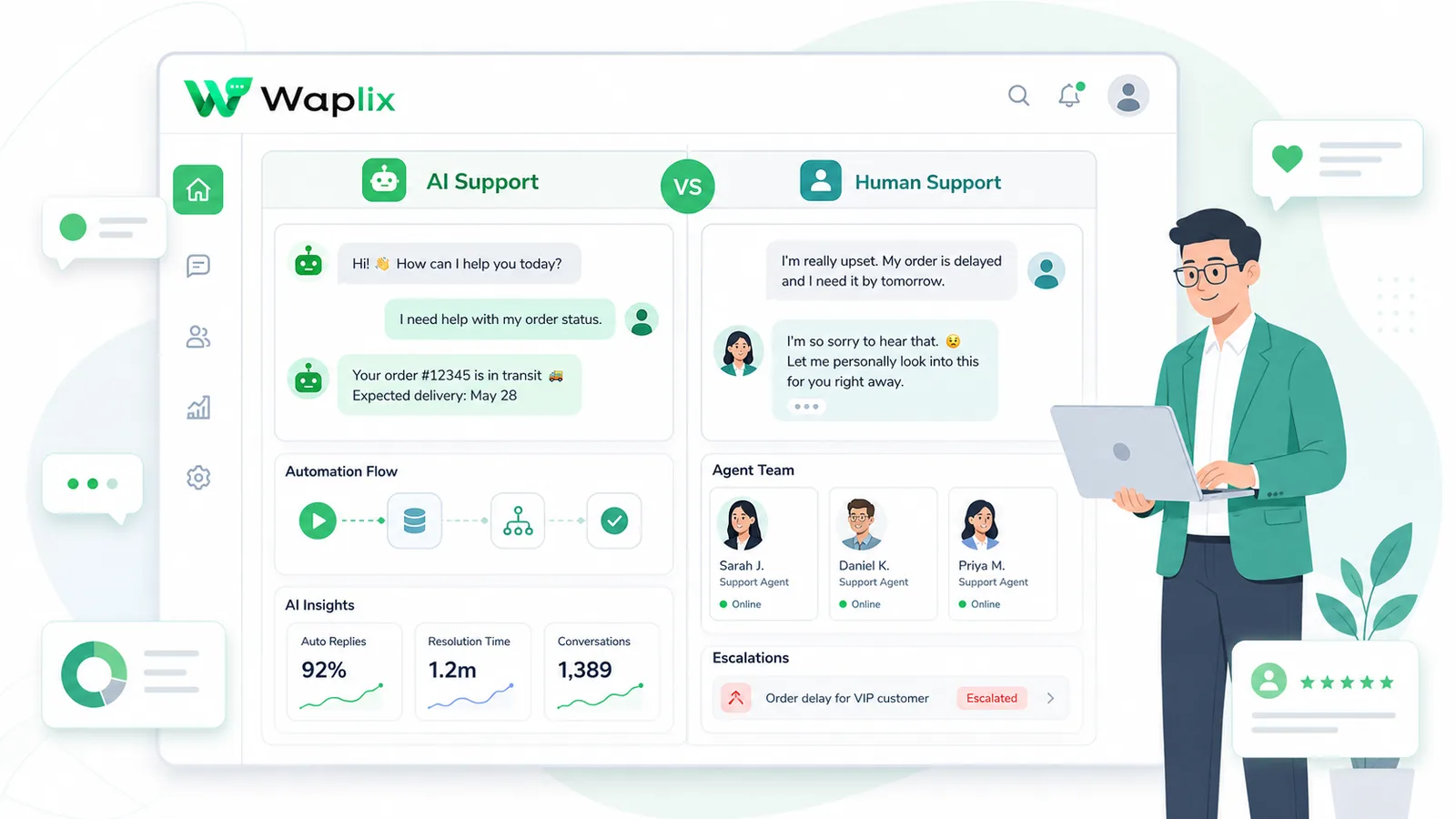
AI vs human support: side-by-side comparison

The comparison is not about intelligence alone. It is about fit for task, customer expectations, and operational design.

FactorAI supportHuman support
Response speedOften instant for common questionsDepends on queue and staffing
ScaleHandles many conversations in parallelLimited by agent capacity
EmpathyCan feel robotic if poorly designedStronger for emotional situations
JudgmentWeak on exceptions and policy nuanceStrong for case-by-case decisions
ConsistencyHigh when knowledge base is goodVaries by agent experience and mood
Cost modelPlatform + maintenance + content workStaffing, training, and shift coverage
Trust recoveryCan damage trust quickly when wrongBetter at repairing difficult conversations

Key takeaway

Ask “Which part of support are we comparing?” first. First response, resolution, escalation, and retention all behave differently for AI and humans.

Where AI support performs best

AI is most valuable when the work is repetitive, structured, and measurable. That makes it a strong fit for modern messaging channels where customers expect immediate answers.

  • Answering FAQs from a maintained knowledge base
  • Collecting order numbers, emails, or issue details before handover
  • Routing conversations by intent: billing, sales, technical, complaint
  • Providing instant first responses outside business hours
  • Qualifying leads with structured questions

On WhatsApp, AI can reduce the “we will get back to you” delay that frustrates customers on personal channels. But quality depends on content, routing rules, and escalation design—not the model name alone.

Tip: Measure AI support by handover quality and resolution outcome, not only by how many chats it answered first.

Where human support still wins

Some support moments are not information problems. They are trust problems. Humans still outperform AI when the conversation requires nuance, discretion, or emotional intelligence.

Refunds and exceptions

Policy edge cases often need approval and judgment.

Angry customers

De-escalation requires tone, patience, and authority.

High-value sales

Complex deals benefit from consultative conversation.

Technical ambiguity

Unclear symptoms may need investigation, not scripted replies.

Removing humans entirely usually saves cost upfront and creates bigger retention problems later. Customers remember how they were treated when something went wrong.

The hybrid model: AI first, human when it matters

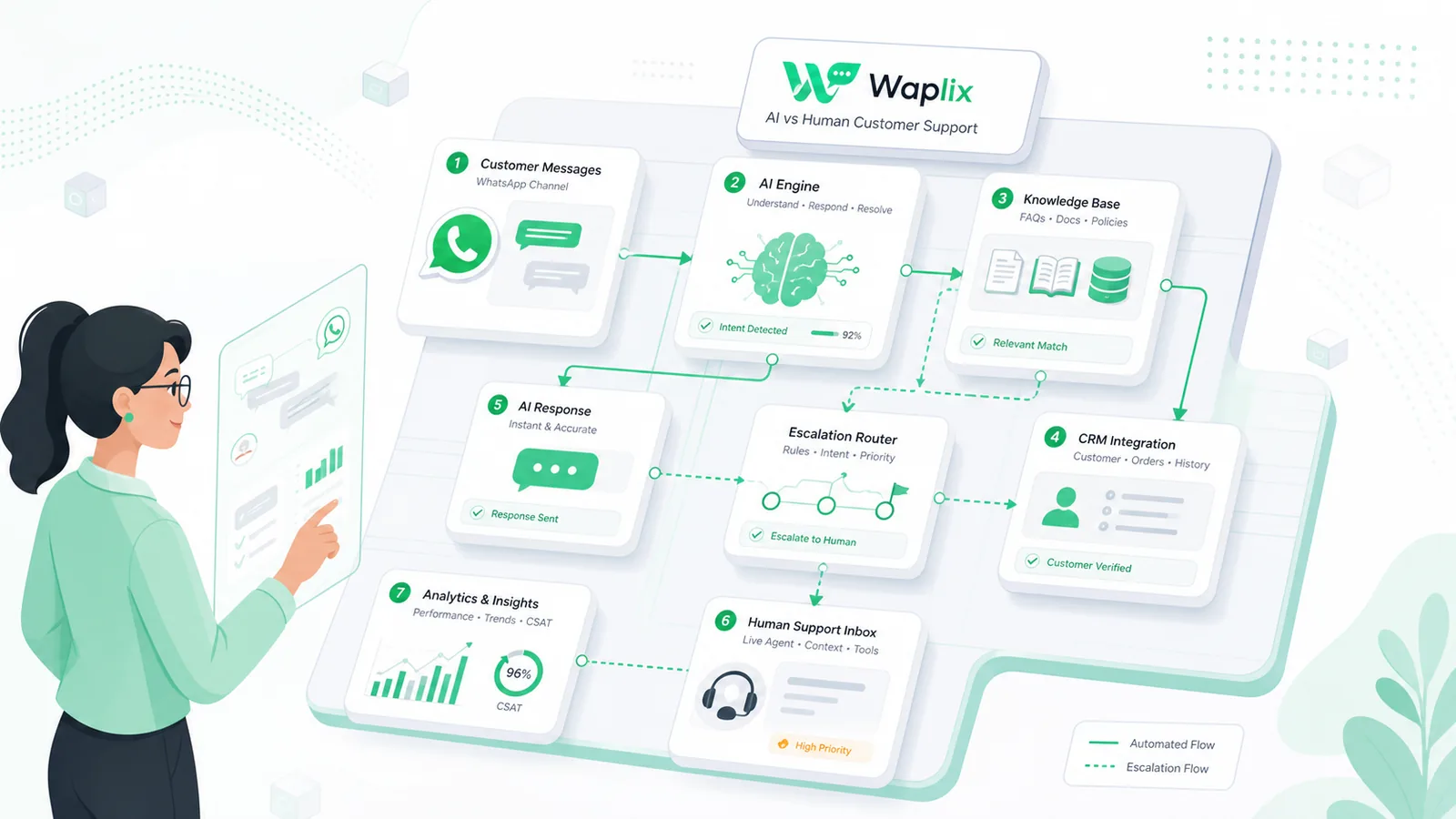
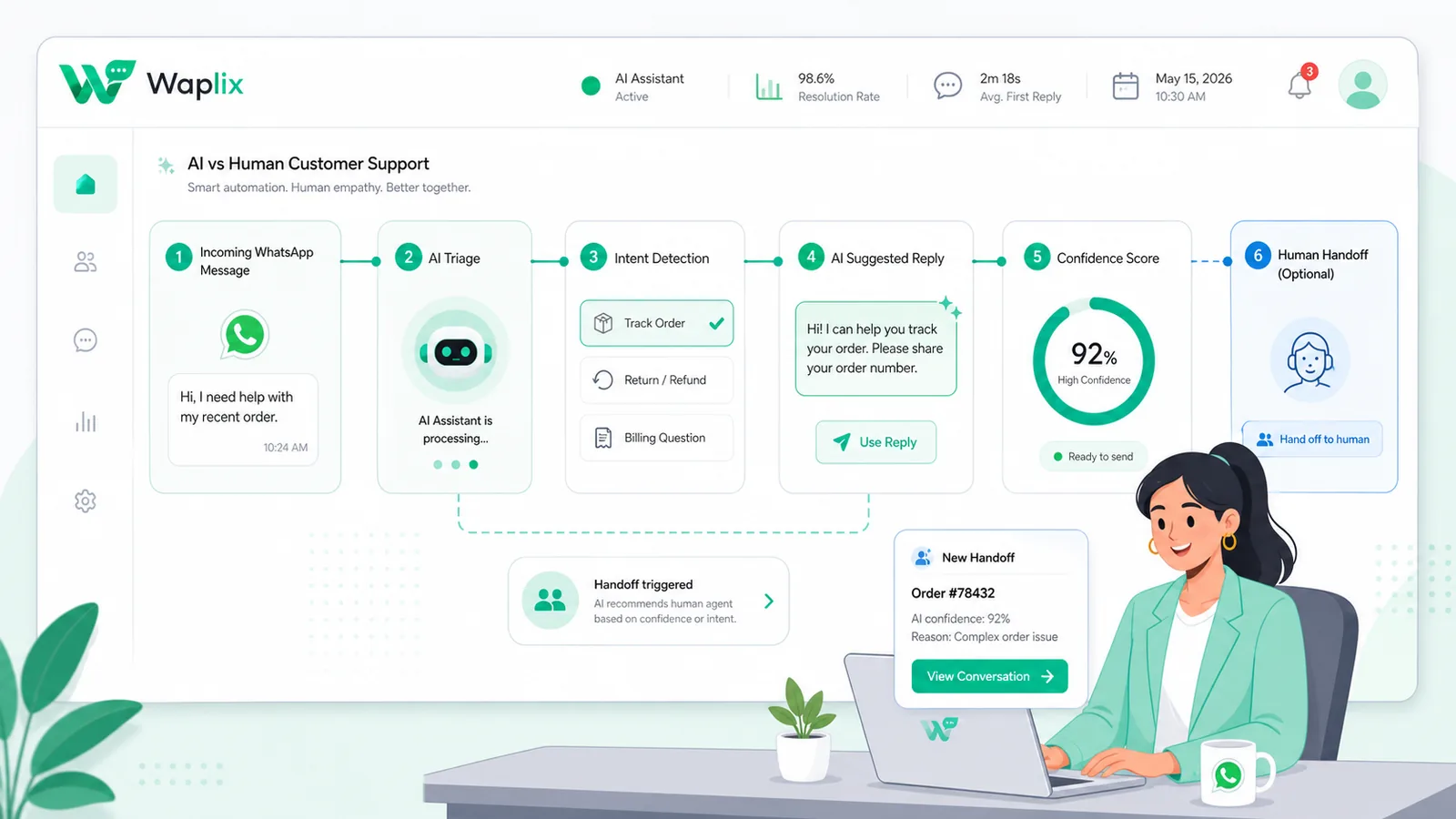
The best support teams are not debating AI vs humans anymore. They are designing handover. AI handles the first mile. Humans handle the critical mile.

01

AI greets and triages

Identify intent and collect basic context quickly.

02

AI resolves simple cases

Answer from approved knowledge or trigger automated actions.

03

Escalation rules fire

Route to humans based on sentiment, topic, or customer request.

04

Agent receives context

Human sees summary, tags, CRM data, and prior messages.

Best practice: Make human help easy to request. A visible “Talk to a person” path protects trust even when AI handles most volume.

Why this matters more on WhatsApp

WhatsApp is not like email or a ticket portal. It feels personal. Customers expect quick replies in a familiar chat interface. That makes both the opportunity and the risk larger.

AI can perform well on WhatsApp when responses are concise, accurate, and easy to escalate. It fails when customers feel trapped in automation loops or receive generic answers that ignore their situation.

Human agents also need better tooling on WhatsApp: shared inbox, assignment, tags, CRM context, and conversation history. Without that, even human support becomes slow and inconsistent at scale.

Decision framework: AI, human, or both?

ScenarioRecommended approachWhy
Order status inquiryAI firstStructured data, low emotional risk
Refund disputeHuman-led with AI prepNeeds judgment and authority
Product FAQAI firstHigh volume, repeatable answers
Complaint after bad experienceFast human escalationTrust recovery matters most
Lead qualificationAI first, human closeEfficiency plus sales nuance
Technical outage reportAI triage + human supportUrgency and uncertainty are high

Developer view: handover events and support routing

Hybrid support becomes real when your messaging platform can emit structured handover events and route conversations to the right queue.

Handover webhook example

{
  "event": "support.handover",
  "conversation_id": "conv_7120",
  "reason": "negative_sentiment",
  "summary": "Customer reports duplicate charge and wants refund.",
  "priority": "high",
  "channel": "whatsapp"
}

Agent reply example

POST /api/v1/messages/send
Authorization: Bearer YOUR_API_KEY
Content-Type: application/json

{
  "to": "+15551234567",
  "type": "text",
  "message": "Hi Sam, I am taking over your case and reviewing the duplicate charge now."
}
Authentication note: Support automations should run server-side with protected credentials, searchable logs, and retry-safe webhook handling. Never expose API keys in client-side chat widgets or public scripts.

See the webhook documentation and API documentation for production routing patterns.

See Waplix features

Build hybrid support with AI agents, shared inbox routing, CRM context, and WhatsApp messaging automation.

See Waplix features View Waplix pricing

Cost comparison: what teams forget to measure

AI support looks cheaper when you count only software subscription cost. Human support looks expensive when you count only salaries. Total cost is more nuanced.

Cost areaAI supportHuman support
Direct costPlatform, AI usage, integrationsAgent wages and shift coverage
Hidden costKnowledge maintenance, prompt tuning, QA reviewTraining, turnover, supervision
Failure costWrong answers, churn, complaint spikesSlower response, queue backlog
Best metricResolution quality + handover efficiencyCSAT, resolution time, retention impact

How Waplix supports hybrid AI + human support

Waplix is built for teams that want both automation and control. Instead of forcing a binary choice, it helps businesses run AI-assisted WhatsApp support with human handover, shared inbox operations, CRM context, webhook automation, and reporting in one place.

That matters because hybrid support fails when AI and human systems are disconnected. Waplix keeps the conversation history, routing rules, customer data, and escalation path in the same operational layer.

Waplix AI support agent screenshot placeholder

Replace this with a real Waplix AI agent screenshot showing escalation and knowledge base settings.

Suggested screenshot: AI agent configuration with handover triggers and fallback rules.
Shared inbox screenshot placeholder

Replace this with a real Waplix inbox screenshot showing human takeover after AI triage.

Suggested screenshot: inbox with AI summary, assignment, and customer CRM context.

Explore the AI agent docs and read how AI is changing WhatsApp customer support for a channel-specific view.

Common mistakes in the AI vs human debate

  • Treating AI as full replacement. Complex support still needs humans.
  • Rejecting AI entirely. Teams miss efficiency gains on repetitive work.
  • No escalation path. Customers feel stuck when automation fails.
  • Weak knowledge base. AI scales wrong answers faster than humans do.
  • Comparing only cost. Retention and complaint volume matter too.
  • Ignoring channel context. WhatsApp support needs tighter tone and faster handover.

Best practices for hybrid customer support

Define escalation rules

Document when AI must stop and a human must take over.

Review failed chats

Weekly review improves both knowledge content and routing logic.

Preserve context

Agents should never ask customers to repeat information already shared.

Measure the full journey

Track response time, resolution, CSAT, and repeat contact rate together.

Final recommendation

AI vs human customer support is not a winner-take-all contest. AI wins speed and scale. Humans win judgment and trust repair. Customers win when businesses combine both without friction.

If you operate on WhatsApp, the hybrid model is even more important because the channel feels personal and immediate. Use AI to remove delay and repetition. Use humans where the conversation truly matters.

Automate WhatsApp communication with Waplix

Launch hybrid support with AI agents, human handover, inbox workflows, and WhatsApp automation from one platform.

Create your free Waplix account Talk to Waplix

Frequently Asked Questions

Neither is better in every situation. AI is usually stronger for speed, scale, and repetitive questions. Humans are stronger for empathy, judgment, exceptions, and emotionally sensitive cases. The best support models combine both with clear handover rules.

For most businesses, no. AI can reduce repetitive workload and improve first-response time, but customers still need humans for refunds, complaints, complex troubleshooting, sales negotiations, and situations where trust and tone matter deeply.

Start with FAQs, order-status questions, business hours, appointment confirmations, basic qualification, and simple troubleshooting. These tasks are high-volume, lower-risk, and easier to measure before expanding automation further.

Escalate when the customer asks for a person, when sentiment turns negative, when policy exceptions are needed, when billing or refund decisions are required, or when the AI confidence score is low and the answer could be wrong.

It can, if automation is poorly designed. Customers dislike wrong answers, loops, and blocked access to humans. Satisfaction often improves when AI reduces wait time for simple issues while making human help easy to reach for complex ones.

WhatsApp feels personal, so bad automation stands out quickly. AI works well on WhatsApp when replies are accurate, context is preserved, and handover to a shared inbox is seamless. Customers expect fast help in a channel they already trust.

A hybrid model uses AI for triage, first response, and common questions, then routes complex cases to human agents with conversation summaries and CRM context. This improves efficiency without removing human judgment from important moments.

Waplix combines WhatsApp messaging, AI support agents, shared inbox workflows, CRM context, webhooks, and analytics so teams can automate common conversations while keeping human handover, routing, and quality control in one platform.

Related Guides & Insights

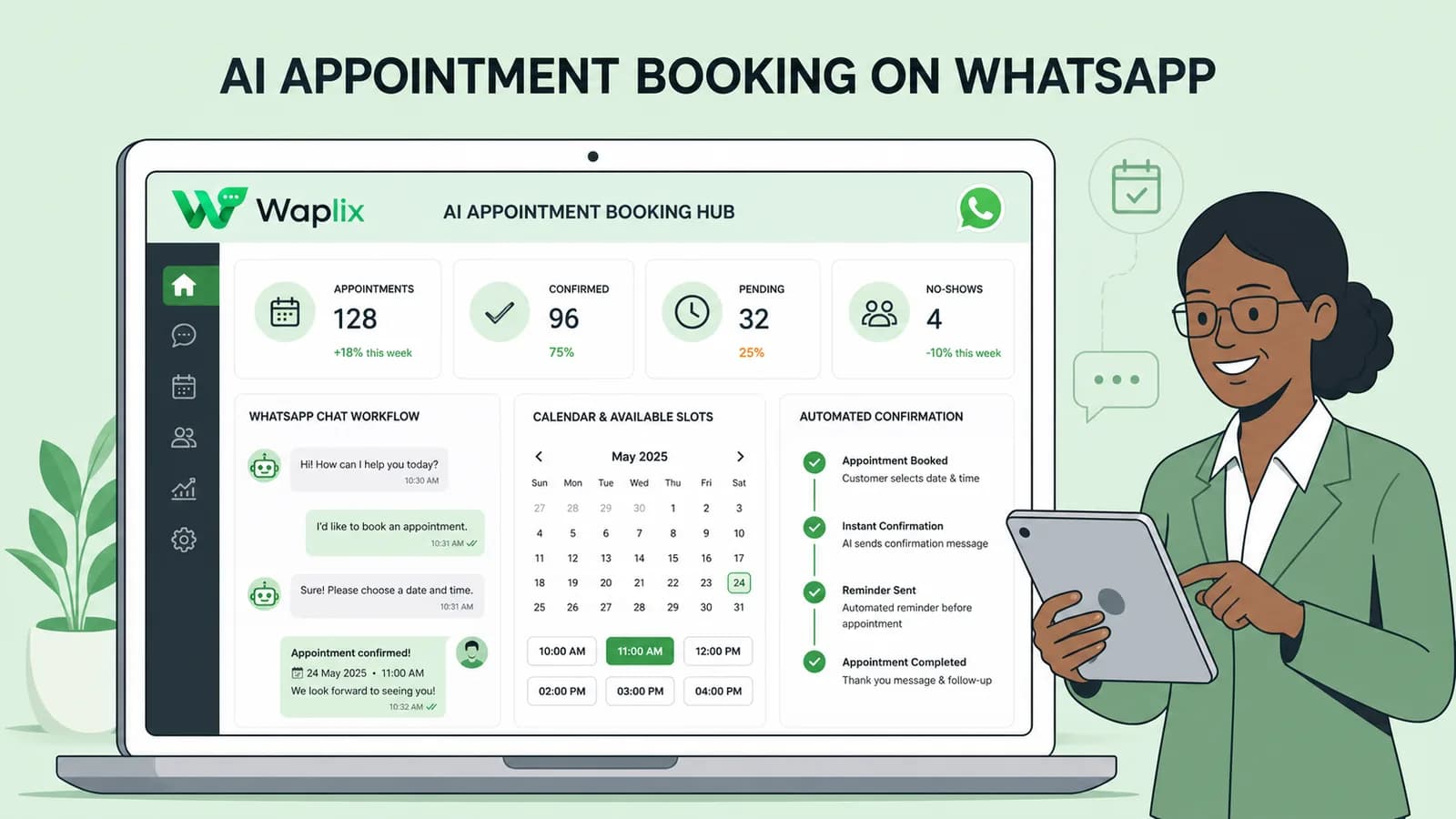
AI Appointment Booking on WhatsApp
AI Agents

AI Appointment Booking on WhatsApp

Learn how to build AI-driven booking systems on WhatsApp, connecting calendar databases to conversational agents, automating updates, and reducing client no-shows.

Read Article
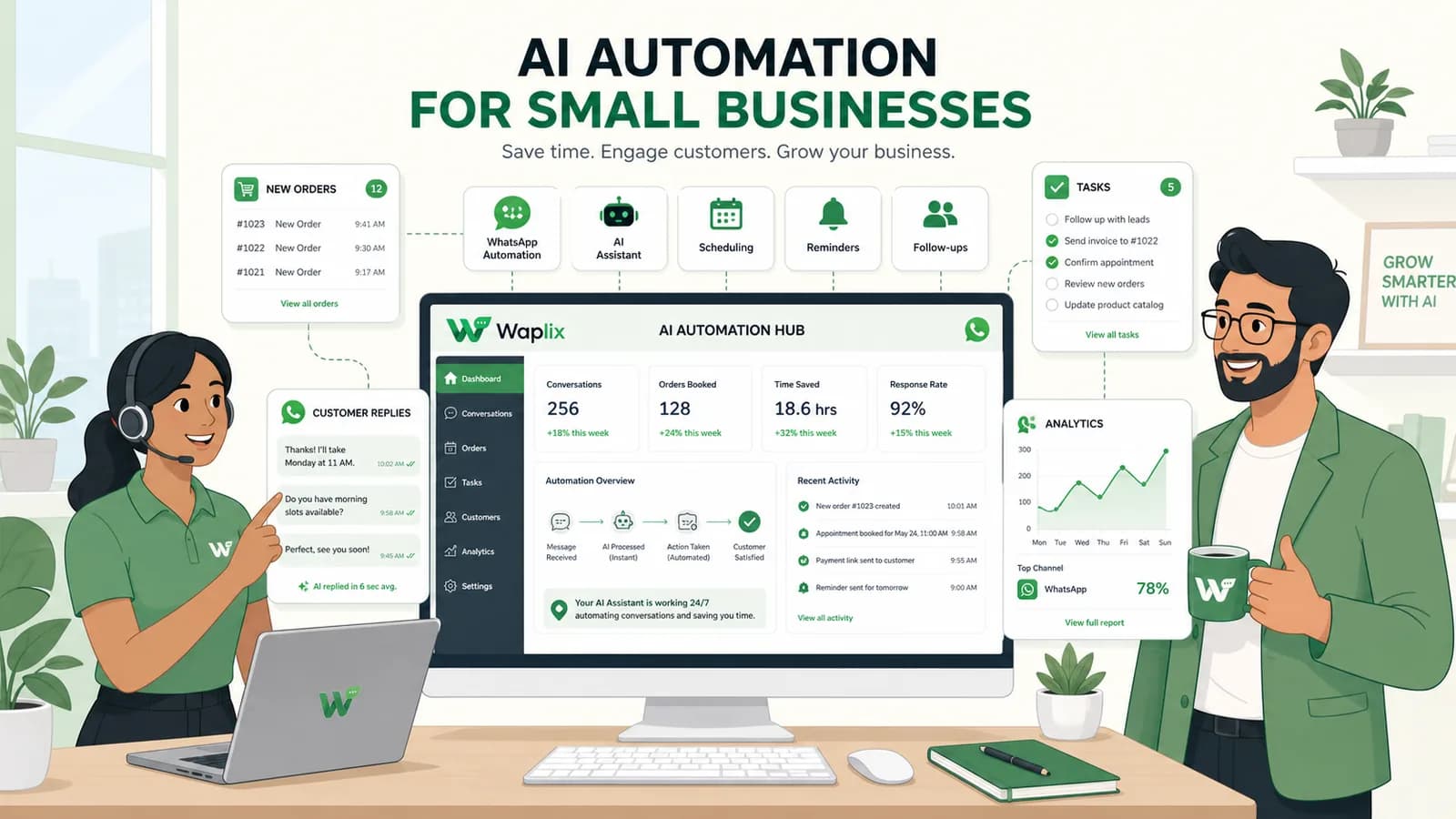
AI Automation for Small Businesses
AI Agents

AI Automation for Small Businesses

Discover practical ways small businesses can leverage no-code AI automation on WhatsApp to manage customer conversations, qualify prospects, and coordinate bookings 24/7.

Read Article
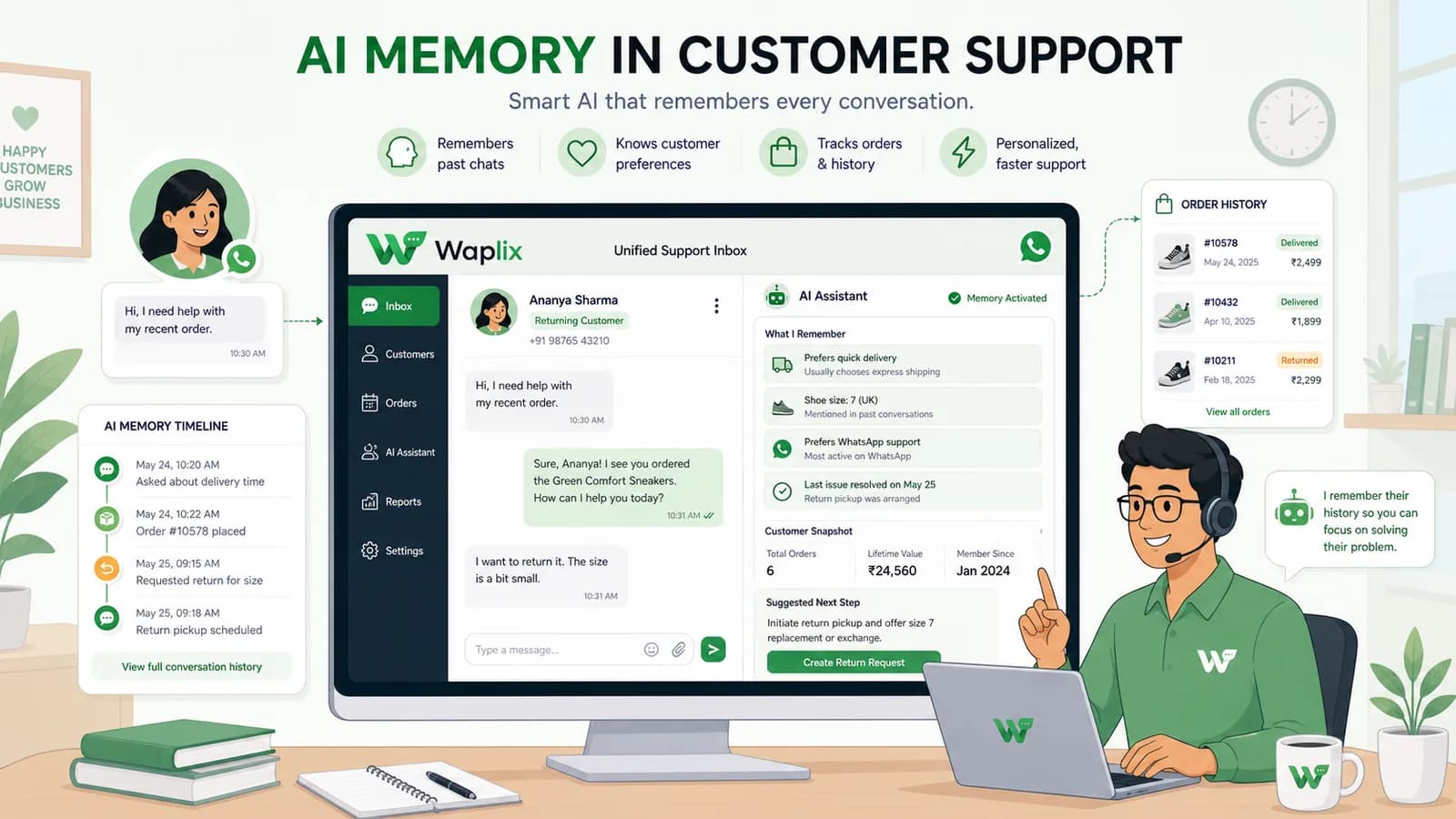
AI Memory in Customer Support
AI Agents

AI Memory in Customer Support

Explore the technology behind AI memory and context retention, learning how session databases personalization results in better, trust-filled client interactions.

Read Article